


Introducing ECG-AI® LEF: FDA-Cleared AI Algorithm to Detect Low Left Ventricular Ejection Fraction
Breakthrough Software as a Medical Device (SaMD) to aid clinicians in detecting low ejection fraction (LEF) earlier than ever before.

Our Breakthrough Technology
Developed in partnership with Mayo Clinic and nference

Developed using over 100,000 ECGs and echo data pairs from unique patients

Evaluated in 30+ studies across multiple institutions in the US and internationally

ECG-AI® LEF is Clinically Proven to Detect Low Ejection Fraction (LEF) Early
ECG-AI LEF is a highly effective screening tool for identifying low EF and has the potential to help clinicians uncover more LEF cases.
Designated as a breakthrough device by the FDA in 20192
FDARobust clinical data across a diverse patient population3
ECG-AI LEF is a state of the art deep learning model trained and validated on over 100,000 data pairs from unique patients1,3.
In a multi-site, geographically-diverse, retrospective validation study with more than 16,000 patients, ECG-AI LEF demonstrated.

References:
- Lorem ipsum dolor sit amet, consectetur adipiscing elit, sed do eiusmod tempor incididunt ut labore et dolore magna aliqua.
- Ut enim ad minim veniam, quis nostrud exercitation ullamco laboris nisi ut aliquip ex ea commodo consequat.
- Duis aute irure dolor in reprehenderit in voluptate velit esse cillum dolore eu fugiat nulla pariatur. Excepteur sint occaecat cupidatat non proident, sunt in culpa qui officia deserunt mollit anim id est laborum.
Neural Network of ECG-AI® LEF is Well-Studied
Proprietary AI built on vast real world data
An early device version with the ECG-AI LEF neural network was evaluated in 25+ peer reviewed publications in the U.S. and internationally3.
Rigorously evaluated across diverse clinical settings, including inpatient, outpatient, & emergency departments
Pragmatic Clinical Study:4
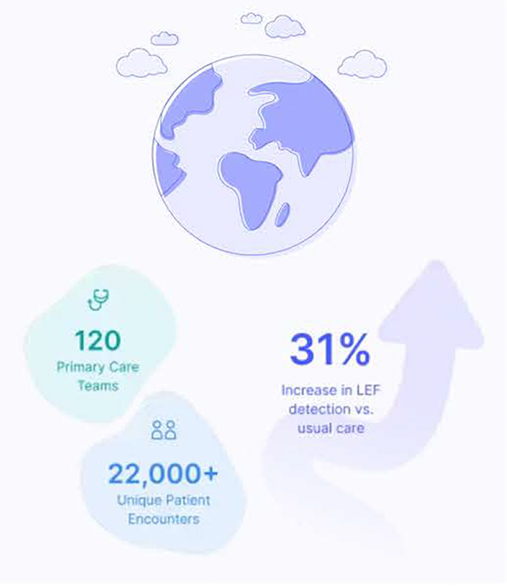
The EAGLE study, a prospective, randomized trial, utilized an early device version of ECG-AI LEF, with the same neural network. This was used by 120 primary care teams across over 22,000 unique patient encounters. The study demonstrated a 31% increase in LEF detection compared to the standard of care alone, without increasing the utilization of echocardiography. Moreover, the majority of patients where LEF was detected received additional treatments.
References:
- Lorem ipsum dolor sit amet, consectetur adipiscing elit, sed do eiusmod tempor incididunt ut labore et dolore magna aliqua.
- Ut enim ad minim veniam, quis nostrud exercitation ullamco laboris nisi ut aliquip ex ea commodo consequat.
- Duis aute irure dolor in reprehenderit in voluptate velit esse cillum dolore eu fugiat nulla pariatur. Excepteur sint occaecat cupidatat non proident, sunt in culpa qui officia deserunt mollit anim id est laborum.
FAQS
Is ECG - AI LEF ava ilable now? And how do I get access to it?
Yes, ECG AI LEF is available now in the U.S. and is eligible for reimbursement for medicare patients in outpatient settings. To bring ECG AI LEF to your facility, contact us
If a Low EF is detected, how would it notify me?
Results are provided as a binary output within your EHR. When you view the ECG AI™ LEF result within your EHR, the algorithm will inform you whether it has detected Low LVEF or not
How accurately does the algorithm predict low EF?
In the validation study with 16,000 patients, the algorithm demonstrated an 84.5% sensitivity and 83.6% specificity. The algorithm also achieved an AUROC of 0.932
AUROC – The AUROC measures how well a test can discriminate between 2 outcomes, in this case, EF <= 40% vs. EF > 40%. A perfect score of AUROC is 100% . A score ≥0.90 is considered excellent8) and better than most tests currently used in heart failure standard of care. For example, NT – proBNP, a common blood test used to help identify LEF today has an AUROC of 0.83
What do specificity and sensitivity mean?
- Sensitivity: ability to correctly identify patients with a disease/condition
- A high sensitivity means that there are few false negative results, meaning fewer cases of disease are missed
- Specificity: the ability of a test to correctly identify patients without the disease
- A high specificity means that there are few false positive results.
How diverse is your dataset?
There were patients of various racial diversity in the validation study, mirroring the racial diversity of the U.S.; including Asian, Black, Hispanic, and white, and the sensitivity and specificity data was similar across the racial groups
What is the clinical benefit of identifying LEF earlier?
HF is a progressive disease, and later stages are associated with increased mortality.
If patients can be identified earlier, they can be treated earlier and potentially lead to better outcomes
Quality improvement of Echo workload – identifying new patients and secondary signal for triaging existing patientsHow is the AI identifying low EF that I cannot?
Traditional 12 – lead ECGs capture electrical signals from the heart, but their analysis often relies on linear rules and limited patterns.
Anumana’s ECG – AI elevates ECG analysis by harnessing deeplearning, uncovering subtle and unknown signals, and complex interdependencies. This breakthrough technology identifies difficult-to-diagnose cardiac conditions earlier, even before obvious symptoms or conventional ECG abnormalities emerge.
Don’t see the answer you’re looking for? Get in touch with our team, and we will be happy to help!